Scheduling on Sherlock#
Job distribution across nodes#
In a shared cluster, many jobs run concurrently across different subsets of nodes. The scheduler packs jobs together to keep utilization high, leaving only small gaps between allocations.
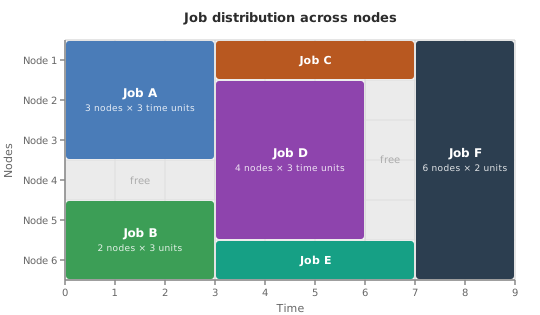
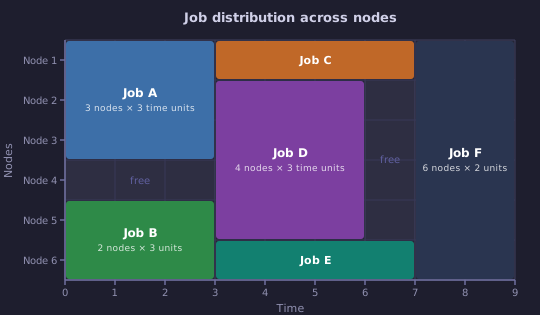
The diagram above shows how six jobs with different node and time requirements are laid out across six nodes over nine time units. Jobs A and B fill most of the cluster at t=0–3, leaving only Node 4 free (later filled by Job D). Jobs C through E run concurrently at t=3–6/7, followed by Job F which spans all six nodes.
A few things to observe:
- Large jobs (like Job F, 6 nodes) must wait until all required nodes are simultaneously free, which typically means a longer queue wait.
- Small jobs (like C and E, 1 node each) can often start right away by fitting into gaps left by larger jobs.
- Free slots (shown in grey) represent idle capacity the scheduler will try to fill.
Backfill scheduling#
Slurm does not run jobs strictly in priority order. Instead it uses a backfill strategy: the scheduler looks ahead in the queue and starts lower-priority jobs early if doing so will not delay any higher-priority job's reserved start time.
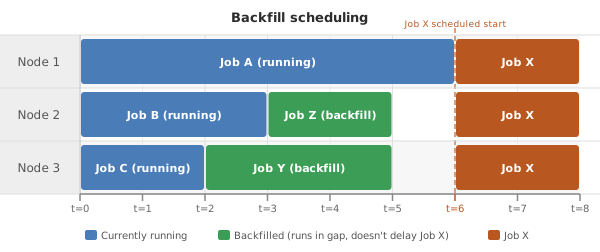
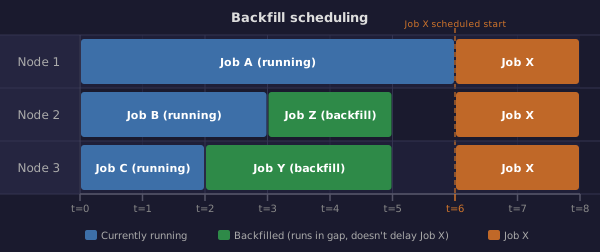
In the diagram above, high-priority Job X has a reserved start at t=6 when enough resources free up. Rather than leaving those resources idle until then, Slurm fills the gap with lower-priority jobs Y and Z, which finish before Job X needs to start.
The practical effect is that a job with a small resource footprint or a short time limit is much more likely to slip into a gap and start immediately, while a large job may have to wait until enough nodes are free at the same time.
Job priority and fairshare#
When a job is pending with the reason Priority, it means the scheduler has identified higher-priority jobs that need to start first before resources can be allocated to yours. This is the most common pending reason on a shared cluster.
Job priority is determined by several factors, including job age, requested resources, partition, and fairshare score. The fairshare score accounts for each user's past resource consumption: the more CPU and GPU hours you have used recently, the lower your next jobs' priority will be. This effect decays over time, so past usage is progressively forgotten and your priority recovers as your recent consumption normalizes relative to other users.
Pending times also depend on overall cluster load and can grow substantially during busy periods, regardless of your individual fairshare score. There is no fixed upper bound on how long a job may wait.
Reducing wait time with accurate resource requests
A job that requests fewer nodes, less memory, or a shorter time limit has a higher chance of fitting into a gap between larger reservations via backfill (see Backfill scheduling above). If your pending times are long, review your resource requests and make sure they reflect your job's actual needs rather than a conservative overestimate -- in particular, an accurate time limit makes a significant difference.
Dedicated resources for persistent queue pressure
If pending times consistently hinder your ability to get work done, Stanford Research Computing offers faculty members the option to purchase dedicated compute nodes on Sherlock. Owners get guaranteed priority access to their nodes, and those nodes contribute to the shared pool when idle. See Investing in Sherlock for details.
Implications for your jobs#
- Request only the nodes and time your job actually needs. Overestimating the time limit reduces the chance that a backfill slot is available.
- Use job arrays for many independent tasks rather than requesting a large number of nodes at once.
- Short, small jobs get priority access to backfill slots and can often start within minutes even when the cluster is busy.